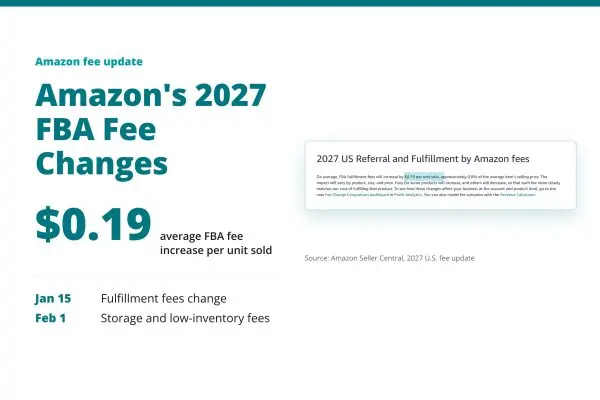
Amazon announced its 2027 U.S. fee updates on November 5. FBA fulfillment fees will rise by an average of $0.19 per unit sold, about 0.8% of the average item’s selling price, with most changes taking effect January 15, 2027.
Your actual fee may go up or down depending on the product’s size and price. The FBA fuel and logistics surcharge Amazon added in April 2026 stays where it is.
The $0.19 average is the headline, and the February 1 storage change is where the bill really moves for brands carrying slow stock.
3 Dates Set Your 2027 Fee Exposure
| Amazon’s 2027 U.S. FBA changes at a glance | ||
| Effective | Change | What it means |
|---|---|---|
| Jan 15, 2027 | FBA fulfillment fees | Average increase of $0.19 per unit sold. Some fees rise and some fall by size and price |
| Feb 1, 2027 | Storage fees | Storage utilization surcharge removed. Aged inventory surcharge folded into 1 age-based monthly rate |
| Feb 1, 2027 | Low-inventory-level fee | Applies below 28 days of supply, measured on actual shipments 4 weeks before and 4 weeks after the assessment date |
| No change | Fuel and logistics surcharge | Stays at its current level. Amazon says it will keep reviewing it |
Amazon’s announcement also flags updates for small and large standard-size items, items priced above $50, “Buy X, Get Y” promotions, Multi-Channel Fulfillment and Amazon Warehousing and Distribution. Check each one against your catalog before January 15.
RELATED: Amazon Announces AWD, MCF & Buy with Prime Fee Increases for 2026
Age Is the New Storage Variable
Starting February 1, Amazon drops the storage utilization surcharge and rolls the aged inventory surcharge into a single age-based monthly storage rate. Amazon says inventory that sells within 6 months will cost the same or less to store. Older stock will cost more.
That shifts the question from how much space you use to how long each unit sits. A fast mover can come out ahead under the new structure. A slow mover pays more the longer it sits.
Before your next FBA shipment
Send FBA the stock that will sell inside 6 months. Hold the rest where you pay for the pallet positions you actually use.
RELATED: Interactive Post: The Storage Math Behind Every FBA vs. 3PL Decision
The Low-Inventory Fee Now Rewards Steady Replenishment
The low-inventory-level fee is currently assessed on trailing 30-day and 90-day sales. From February 1, it applies only when a SKU drops below 28 days of supply, and Amazon will measure that supply on actual shipments in the 4 weeks before and the 4 weeks after the assessment date.
Amazon says the change targets SKUs that genuinely need replenishment and cuts triggers from unexpected demand spikes and end-of-season or end-of-life products. For you, it means the fee follows how consistently you keep FBA stocked, so a buffer outside Amazon that can replenish on a steady cadence matters more than it did.
Your Slow Movers Need a Decision Before February
The storage change and the low-inventory change point the same direction. Keep FBA lean enough that nothing ages past 6 months, and keep it full enough that no SKU drops below 28 days of supply.
That only works with inventory staged outside Amazon. With Tactical’s 3PL warehousing, inbound inventory is scanned and racked within 48 hours, there are no storage minimums or maximums, and you pay only for the pallet positions you use. Replenishment into FBA then runs on your schedule.
WATCH: AWD vs. Tactical Calculator
If you already know which SKUs are aging, start there.
RELATED: How to Handle Aged Inventory and Returns Through Q4 and Q5
The Tactical Takeaway
The per-unit increase is small and mostly out of your control. Storage age and replenishment cadence are fully in your control, and they’re where 2027 margin gets won or lost. Before January 15:
- Open the Fee Change Comparison dashboard in Profit Analytics and check your highest-volume SKUs.
- Model any SKU priced above $50 or running “Buy X, Get Y” promotions in the Revenue Calculator.
- Flag every SKU likely to sit in FBA past 6 months.
- Set a replenishment cadence that keeps each FBA SKU above 28 days of supply without overfilling it.
Book a call with the Tactical team to sort which inventory belongs in FBA and which belongs in a buffer before the February 1 storage change.