

Most sellers can tell you exactly how much they’re spending on ads, product, and Amazon fees. Far fewer can tell you how much money they’re losing between those line items, in timing, inventory decisions, and backend assumptions that quietly stopped being true.
In 2026, that blind spot is getting more expensive and the reason isn’t just higher fees. It’s that Amazon’s fulfillment ecosystem, especially AWD, has shifted from an optional optimization tool to a core part of the Amazon ecosystem.
So the question becomes: must sellers put all of their eggs in the Amazon basket? Or is there a way to balance Amazon-first solutions with third-party tools, to maintain better margins and more control over your business?
Understand This: AWD in 2026 Is No Longer Neutral
For years, AWD lived in the “maybe” category. Some sellers used it, some ignored it, and many treated it as a temporary overflow solution. That era is over.
In 2026, AWD has become one of Amazon’s primary mechanisms for rewarding sellers who fit its efficiency model, all while charging everyone else a pretty price. Storage rates rose again in January, with West Coast fees jumping materially. Transportation into AWD also climbed. At the same time, Amazon introduced new incentives and penalties that make AWD harder to opt out of cleanly.
Most notably, auto-replenishment from AWD is now positioned as a release valve for low-inventory fees. Keep bulk inventory in AWD, let Amazon control the flow into FBA, and enjoy the alleviation of certain penalties. This is all part of Amazon’s broader theme for 2026, treating “efficiency as a moat.”
The result is a system that looks efficient on the surface, but behaves very differently depending on who’s using it.
Why Seller Experiences With AWD Are So Polarized
If you read seller forums or talk to operators directly, AWD sounds either like a smart unlock or a complete nightmare. That split isn’t random.
On the positive side, large, ops-mature brands with strong forecasting and consistent velocity are increasingly using AWD as a true bulk node. Containers move directly into AWD, inventory auto-replenishes into FBA, and low-inventory fees are avoided entirely. For these sellers, AWD reduces inbound surprises, smooths regional distribution, and can even replace traditional bulk warehousing.
For them, the system works because they already operate inside Amazon’s assumptions: predictable demand, clean ASNs, tight prep, and minimal seasonality.
On the other side, sentiment is loud… and often angry.
Smaller and mid-tier sellers, especially those with diverse catalogs or seasonal spikes, experience AWD very differently. Receiving can be slow, replenishment logic doesn’t always react fast enough to promotions, and inventory can sit in AWD longer than expected before becoming sellable in FBA. When something goes wrong, visibility and recourse are limited.
For these sellers, AWD doesn’t feel like efficiency, but a pseudo-mandatory black box that charges more every year and occasionally loses pallets.
The key insight here is uncomfortable but important: AWD itself isn’t “good” or “bad,” but is highly sensitive to operational nuances.
The same system that protects margin for one seller can quietly destroy it for another.
Know Your Stock: Delivered ≠ Sellable ≠ Fulfillable
Most conversations about AWD focus on per-unit costs. That’s a mistake. The real margin killer is latency.
Inventory that’s technically “delivered” but not received or stock that’s in AWD but not flowing into FBA fast enough. When pallets sit without being moved into Prime eligible or fulfillment-ready, listings slow down and PPC efficiency collapses.
Every extra day inventory isn’t sellable creates downstream consequences: lost rank, suppressed conversion, heavier ad spend to compensate, and higher stockout risk later. None of those show up as a single fee, but instead as degraded performance over time.
This is why so many sellers look at their year-over-year numbers and feel confused. Revenue is flat or up slightly, but net margin is down five or six points. Product costs didn’t explode. Ads went up, but not that much. The missing percentage is often buried in logistics decisions that felt “safer” or “simpler” at the time.
Cutting Costs in The Wrong Places Can Still Cost You
When margins tighten, sellers naturally look for places to cut. Logistics often becomes the target because it feels like a commodity. That instinct is understandable, and frequently wrong.
Choosing the cheapest carrier, the most automated option, or the least hands-on path can reduce visible costs while increasing hidden ones. Shipments that lack live unloads or complete documentation are harder to resolve when something goes wrong. Inventory delays force sellers to throttle ads, slow sales, or overcorrect on forecasting.
In practice, many sellers end up paying less per pallet but more per unit sold once lost momentum, ad inefficiency, and opportunity cost are factored in.
Logistics is boring, but ignoring it or selling it to the lowest bidder can wipe out multiple points of net profit without setting off any alarms.
AWD vs. 3PL Is No Longer a Simple Cost Comparison
In 2026, the real question isn’t “Is AWD cheaper than a 3PL?”
It’s where does the break-even point actually land for your business?
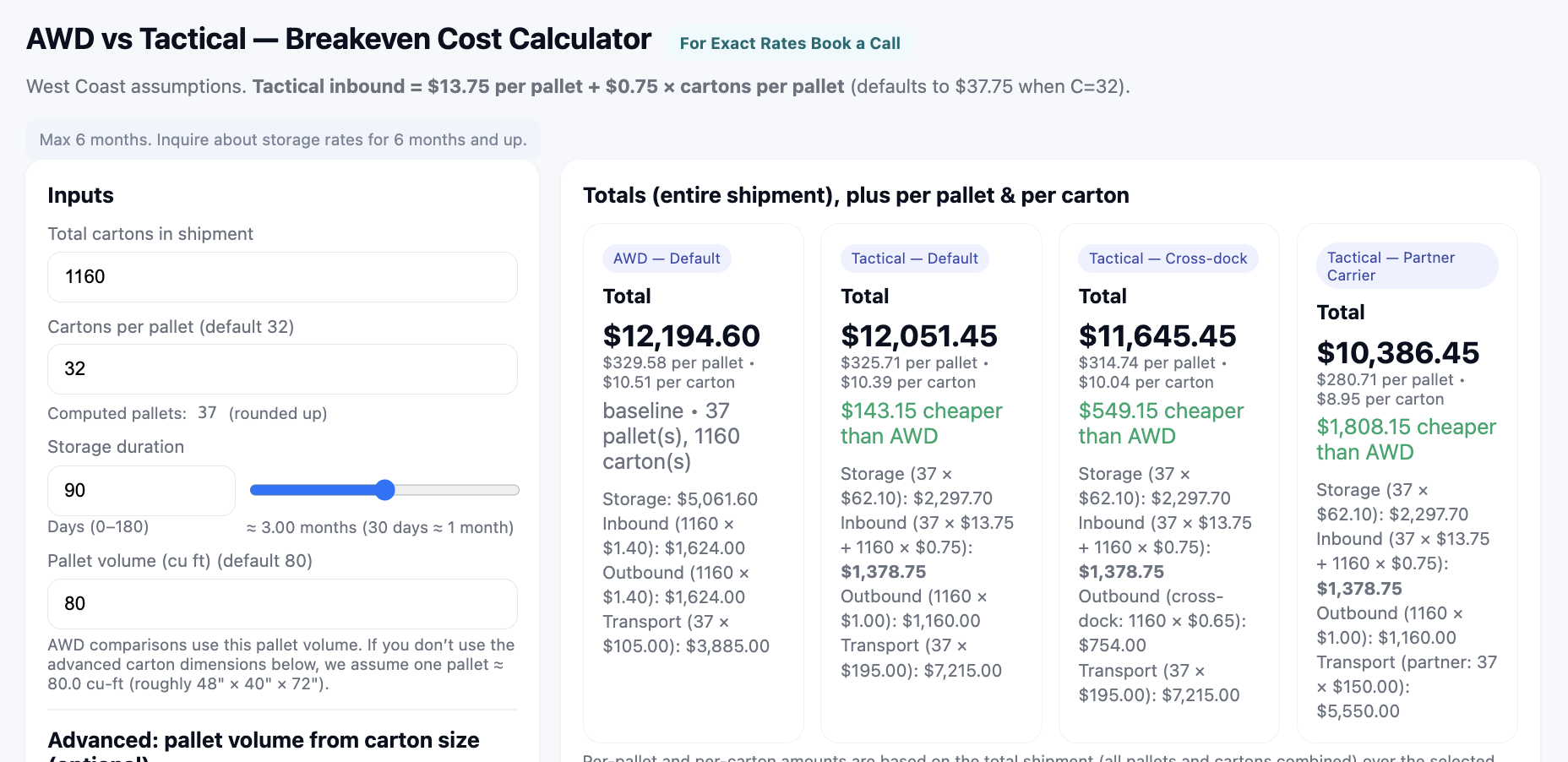
For many sellers, that flip now happens closer to two months of storage, not three. Beyond that window, AWD’s advantages diminish quickly, especially if you need flexibility, faster reaction to promotions, or tighter control over where inventory lives.
This is why static comparisons don’t work anymore. Sellers need to model scenarios: one month vs. three months, West vs. East, steady velocity vs. seasonal spikes.
👉 Run the numbers before guessing
Try our free AWD vs. Tactical calculator to see where your costs actually flip based on storage duration, pallet counts, transfer assumptions, and more.
→ Try the AWD vs. Tactical Calculator
The Risk of Keeping All Your Eggs in Amazon’s Basket
None of this means sellers should abandon Amazon. There is no doubt that Amazon remains the dominant channel for most brands, and will continue to dominate for the foreseeable future. However, relying on Amazon alone in 2026 is riskier than it’s ever been.
Here’s why:
- Fees change mid-cycle.
- Policies shift.
- Fulfillment logic updates without warning.
When something breaks, sellers have fewer levers to pull and less control over recovery time.
That’s why more brands are investing in D2C, TikTok Shop, Shopify, and hybrid models — not just for growth, but for resilience. The problem is that diversification fails when the backend can’t support it cleanly.
RELATED: Omnichannel Fulfillment Strategies for 2026 | TIkTok, D2C, and Beyond
The Strategic Reality for 2026: Serious Sellers Reevaluate Their Supply Chain
AWD is no longer optional or neutral. It’s embedded in Amazon’s economic design.
Sellers effectively have two paths:
Lean into AWD and play the efficiency game with tight forecasting, strict discipline, and acceptance of reduced control; OR, budget for higher all-in Amazon costs while keeping more flexibility in your own network.
From an operations perspective, AWD works best as a specialized bulk node and fee hedge, not as your only warehouse or a full replacement for a responsive 3PL. The strongest setups are designed around AWD’s latency and limitations, not blindly dependent on it.
Watch the Full Interview: 5 Logistics Tips for Sellers in 2026
There’s more nuance behind these decisions than any single article can cover. Hear the full discussion on AWD break-even shifts, inventory delays, fulfillment tradeoffs, and where sellers are unknowingly giving up margin:
🧮 Stress-test your own setup
Before locking into a strategy, run your actual numbers.
→ Use the AWD vs. Tactical Calculator