SplitSmart Expands to Dallas: Faster Amazon Inbound, Lower Costs
It is 7:15 a.m., and your shipment shows as “received” in Amazon Seller Central. By noon, ads are live, traffic is flowing, but the units still are not Prime-eligible. By the end of that week, fees have stacked up, inventory is lagging, and margin has quietly eroded.
The Amazon Inbound Reality
For most high-volume sellers, the real pain starts before a product ever sells. Amazon optimizes inbound for its own network, not for your placement fees or cash flow. Shipments get split across distant fulfillment centers, transfers drag on, and “received” inventory sits days before becoming truly sellable.
That delay hits where it hurts. Ranking slips while you are out of stock in key regions, and ad spend becomes less efficient. Cash stays trapped in inventory that is technically inside the network but not yet available for fast delivery.
Inbound ends up reactive, not strategic. You are waiting on routing decisions you did not make, hoping transfers do not derail your launch calendar.
Why You Don’t Really Control Your Inbound
Amazon placement decisions are built for their grid, not your unit economics. One container can turn into multiple long-haul transfers, each adding time, risk, and cost. Placement fees and unpredictable routing make landed cost harder to forecast.
That uncertainty slows your flywheel. You hesitate to push harder on ads because you are unsure when inventory will truly be available. Your team spends mornings refreshing check-in screens instead of planning the next product or channel.
Inbound should work differently. For serious Amazon sellers, the path from port or origin to Prime needs to be planned, not guessed.
What SplitSmart Does Differently
SplitSmart by Tactical starts with a simple premise: one inbound shipment, pre-planned distribution to multiple Amazon fulfillment centers. Instead of waiting for Amazon to decide how to split inventory, distribution is mapped ahead of time across the Tactical hub network.
That means fewer surprise transfers and faster check-in at the right locations. Inventory is positioned closer to demand from day one, which shortens the window between “received” and Prime-eligible. You get predictability on cost and timing, which makes scaling decisions more confident.
→ Learn more about SplitSmart™
See SplitSmart in Action
Use the interactive distribution visualizer below to see how inventory can move through the SplitSmart network.
What’s New With the Dallas and Chicago Hubs
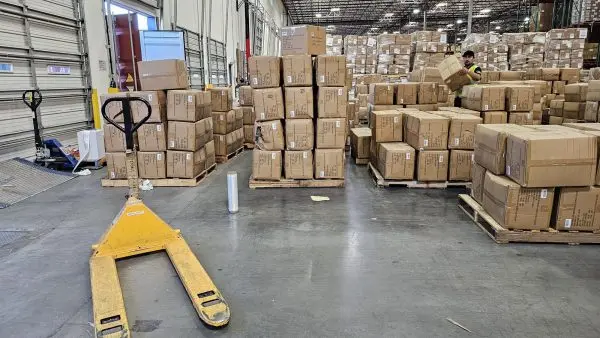
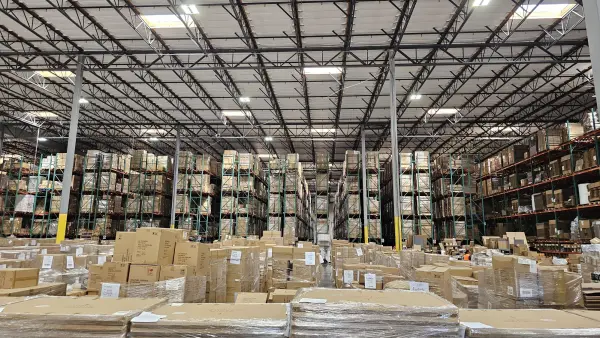
As of this quarter, SplitSmart now operates across California, New Jersey, plus two new hubs in Dallas, Texas and Chicago, Illinois. This is not just another dot on the map; it is a stronger inland network for Amazon-focused distribution.
Dallas sits in a central corridor that reaches major fulfillment centers with shorter linehaul. When containers or inbound pallets feed through Dallas, routing options expand, and miles to key destinations often shrink. The result is faster, more consistent inbound performance for a wider range of SKUs.
Our Chicago hub now gives us operational breadth in the Midwest, expanding our coverage to true North-South-East-and-West.
By the time your shipment has moved from port to hub to fulfillment centers, days have been saved compared with slower, transfer-heavy paths.
Key Fulfillment Centers Served by Each SplitSmart Hub
West Coast (California Hub)
- ONT8 – Moreno Valley, CA
- LGB8 – Riverside, CA
- SNA4 – Irvine, CA
- SMF1 – Sacramento, CA
- PHX7 – Phoenix, AZ
Midwest (Chicago Hub)
-
MDW2 — Joliet, IL
-
MDW4 — Joliet, IL
-
MDW6 — Romeoville, IL
-
MDW7 — Monee, IL
-
MDW9 — Aurora/Naperville area, IL
Central (Dallas Hub)
- DFW7 – Dallas, TX
- FTW1 – Fort Worth, TX
- HOU3 – Houston, TX
- SAT2 – San Antonio, TX
- MDW2 – Joliet (Chicago), IL
East Coast (New Jersey Hub)
- EWR9 – Carteret, NJ
- ABE8 – Bethlehem, PA
- PHL7 – Philadelphia, PA
- BWI2 – Baltimore, MD
- ATL6 – East Point, GA
→ Want to see if SplitSmart is right for your business? Book time with the Tactical team
Before vs After: The Time-to-Prime Gap
Before a structured inbound plan, you see delays, surprise fees, and little control. A container lands, Amazon applies placement logic, and you absorb the transfers. Inventory might sit in a holding pattern while your launch window slips.
With a planned distribution model, pallets are routed intentionally to multiple fulfillment centers from the start. Time-to-Prime tightens, and costs stop swinging wildly from shipment to shipment. That predictability shows up in steadier ranking, more reliable ad performance, and cleaner cash flow.
The real gap is not just port-to-received; it is received-to-sellable. Closing that window is where meaningful margin returns.
Want to Compare AWD vs. Tactical?
Use Tactical’s free calculator to compare storage, inbound processing, and transfer costs so you can pressure-test your current setup and find your breakeven point.
→ Try the AWD vs. Tactical Calculator
Inbound as a Growth Lever, Not a Cost Center
When inbound is predictable, you can plan inventory more aggressively without accepting outsized risk. Faster time-to-Prime means your capital cycles through product more quickly. That supports higher sell-through and healthier profitability on existing catalog.
By the end of a quarter, the difference between reactive inbound and planned distribution is visible in how many times you have turned your best SKUs. Speed and control on the way into Amazon become a real competitive advantage, not a background operational detail.
Conclusion
Adding Dallas to the SplitSmart network is about more than geography. It is about tightening the entire path from port or origin to Prime so you can grow without guessing what inbound will do to your margins.