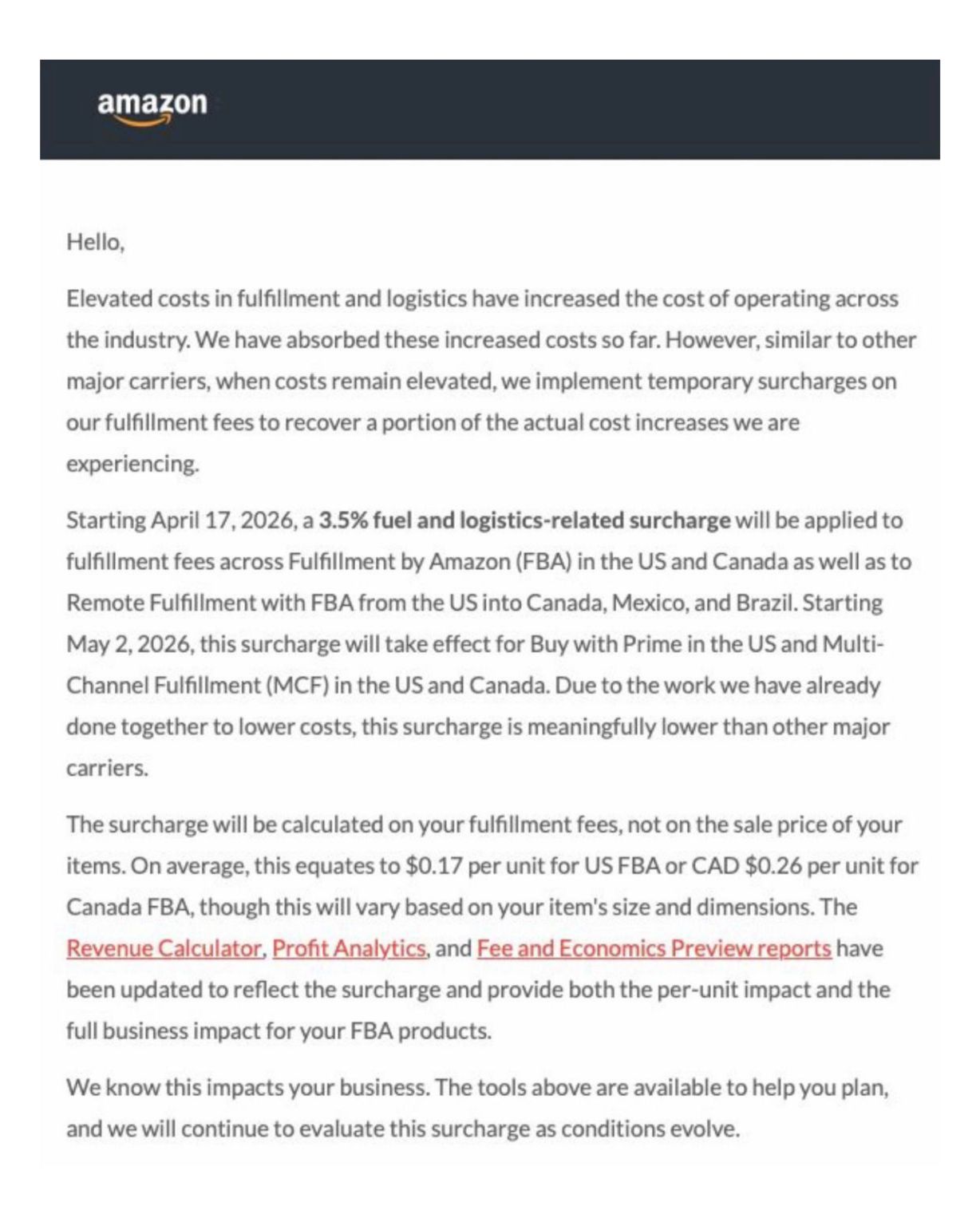
Amazon has officially announced a 3.5% fuel and logistics surcharge on fulfillment fees, and while the percentage may seem small at first glance, the impact on sellers is more meaningful than it appears.
Starting April 17, 2026, the surcharge applies to FBA in the U.S. and Canada, along with Remote Fulfillment. On May 2, it expands to Multi-Channel Fulfillment (MCF) and Buy with Prime.
Amazon Introduces a New Fuel Surcharge
Here’s what that looks like in practice:
- 3.5% added to fulfillment fees (not product price)
- ~ $0.17 per unit on average in the U.S.
- ~ $0.26 per unit in Canada
- Varies depending on size, weight, and category
On its own, this is not a massive increase. But at scale, especially for high-volume sellers or low-margin products, this adds up quickly.
Why Amazon Is Raising Fees Now: Global Fuel Costs (and Long-Term Changes)
Amazon’s reasoning is tied directly to rising global fuel costs. Carriers across the logistics industry have already introduced similar surcharges, including UPS, FedEx, and USPS.
Amazon stated that they had been absorbing these costs but are now passing a portion of them on to sellers.

The key takeaway is not just the fee itself, but how Amazon framed it:
- Described as “temporary”
- No defined end date
- Tied to “elevated cost conditions”
This suggests the surcharge is not a one-time adjustment, but rather a flexible mechanism Amazon can adjust over time.
Rising Costs and Considerations: Why This Is a Flag for Sellers
Most sellers are not reacting to the 3.5% number alone. The concern comes from how this fits into a broader trend of rising costs.
Over the past few years, sellers have already seen:
- FBA fulfillment fee increases
- Higher storage costs and placement fees
- Rising advertising spend
- Increased inbound shipping costs
This surcharge adds another layer. For many brands, it represents:
- ~0.5% to 1% margin compression
- Greater unpredictability in cost planning
- Continued pressure on profitability
There is also added concern around the lack of a clear end date. Historically, “temporary” fees in logistics often become permanent over time.
The Bigger Surprise: MCF Fees Are Included
One of the more unexpected parts of this announcement is that Multi-Channel Fulfillment is also impacted.
This matters because MCF has been a key tool for brands expanding beyond Amazon into:
- Shopify and DTC websites
- TikTok Shop and social commerce
- Other online marketplaces
As MCF costs increase, the gap between Amazon-based fulfillment and independent 3PL solutions continues to narrow.
There is also an important financial detail many sellers overlook. Since fulfillment fees contribute to total revenue, Amazon still takes a percentage on top of those fees. This means the surcharge indirectly increases Amazon’s overall take per order.
Temporary or Permanent? What This Change Signifies for Sellers
While an extra $0.17 per unit may not seem significant at first glance, the real impact depends on your product mix, margins, and volume. For many sellers, this isn’t just about one fee increase. It’s another layer added to already rising costs across FBA, storage, and advertising. Small changes like this tend to compound quickly, especially at scale.
This increase will be felt most by sellers who:
- Sell lower-priced or lower-margin products
- Rely heavily on FBA for all fulfillment
- Operate at high volume where small costs add up fast
- Have limited flexibility in pricing or supply chain strategy
More importantly, this is part of a broader shift. Amazon is no longer absorbing cost volatility the way it once did. Instead, it is passing those fluctuations directly to sellers, just like other logistics providers. That means costs will continue to change, and sellers will need more control over how their operations are structured.
We’re already seeing more brands respond by building flexibility into their supply chain, whether that’s diversifying fulfillment between FBA and 3PL partners, holding inventory outside Amazon, or optimizing inbound and domestic transportation. These adjustments are what help offset rising costs and protect margins over time.
If you want to understand how this impacts your business and where you can reduce costs, our team can help you evaluate your current setup and identify opportunities to improve efficiency.
Book a call with our team to review your logistics strategy and build a more resilient supply chain.