TikTok Shop’s fulfillment strategy has been one of the more capricious e-commerce stories of 2026, and the latest May and June updates give sellers another reason to pay attention.
On May 20, TikTok reduced single-unit FBT fulfillment fees for heavier items in the 16–50 lb weight tiers, cutting per-unit rates by roughly $0.10–$5 depending on weight band and zone. That is a clear win for brands shipping bulky products where most orders ship as a single unit — for example, a 20 lb appliance or piece of exercise equipment that now lands several dollars cheaper on the fulfillment line than it did earlier in the year.
Starting June 18, TikTok is rolling out a new FBT rate card that moves in the opposite direction for many multi-unit scenarios.
Per-unit fees increase for multi-unit orders in the 5–20 lb tiers, narrowing or reversing the discounts that previously made heavier multi-item orders cheaper on a per-unit basis.
At the same time, a more detailed Inbound Incident and Non-Compliance fee structure takes effect, with charges for issues like re-palletization, barcode corrections, hazmat relabeling, and routing failures.
Together, these updates reshape the cost landscape for TikTok sellers.
Heavier single-unit FBT orders get cheaper; heavier multi-unit orders get more expensive; and inbound sloppiness is now a clearly priced liability, not just a headache.
Rate cards define the economics of a fulfillment program — storage, outbound fulfillment, value-added services, non-compliance, and inbound behavior — and they quietly explain how the platform wants inventory to move through its network.
In the case of TikTok, the May and June 2026 changes look like the next step in a broader effort to tighten operational control while still positioning FBT as a growth lever for faster delivery, better conversion, and higher visibility inside TikTok Shop.
Why TikTok’s New Rate Card is Bigger than a Fee Update
TikTok has spent much of 2026 signaling a stronger preference for logistics environments it can monitor more directly. That shows up in FBT itself, but also in tighter rules around shipping labels and routing that constrain how far sellers can stray from TikTok’s preferred processes.
For sellers and service providers, that has created real whiplash. Early-year updates described a harder push toward TikTok-controlled shipping workflows in the U.S., raising concern that sellers would be forced away from their own systems and toward a narrower set of platform-approved options. Subsequent clarifications and reversals walked some of that back — but each new rate card and compliance rule has nudged control back toward TikTok, even when inventory and labor still sit with outside providers.
That is why the May and June rate-card and fee updates matter. For a platform with logistics ambitions, pricing is not just about recouping cost. It is also a way to signal:
- What behavior the platform wants to encourage (e.g., clean, predictable heavy single-unit flows into FBT)
- Which workflows it wants to standardize (e.g., how pallets are built, how cartons are labeled, how SKUs are kitted or de-kitted)
- How much operational discipline it expects from sellers and 3PLs
- How much control it wants over the post-purchase experience, from ship speed to exception handling
What’s Actually Changing: Fees, Incidents, and Value-Add Work
The easiest way to read this set of updates is to break it into three buckets: outbound, inbound, and value-add.
1. Outbound: Single vs. Multi-Unit Orders
- Cheaper heavy single-unit orders (16–50 lb). As of May 20, per-unit FBT fees on these items dropped by about $0.10–$5 depending on tier and zone, making FBT more attractive for large, one-item baskets.
- More expensive heavy multi-unit orders (5–20 lb). From June 18, the new rate card raises per-unit fees on many multi-unit orders in the mid-weight bands, especially where multiple units push a shipment into a higher tier or dimensional band.
A qualitative example: a single 18 lb unit that once cost well over $10 to fulfill might now be around a dollar cheaper, while a three-unit order totaling around 15 lb could see its aggregate fee climb under the June 18 structure. The direction is clear even if the exact dollars vary by tier and zone.
2. Inbound: Incidents and Non-Compliance
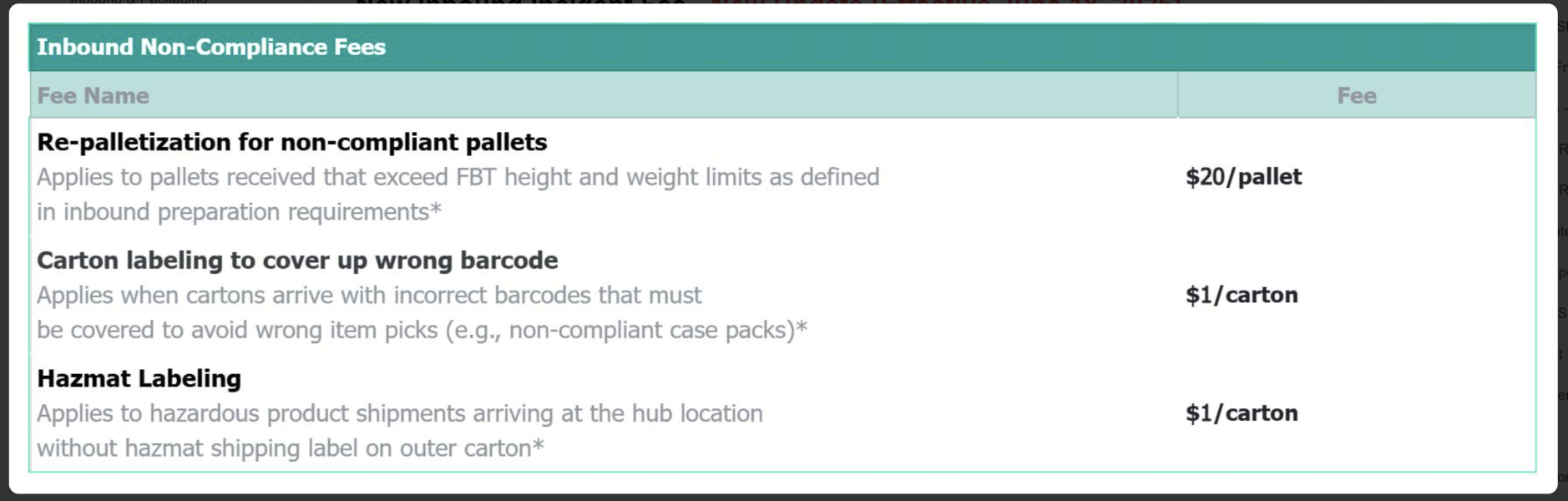
TikTok is also updating how it charges for inbound non-compliance — the “incident” side of the rate card. The broader table (worth linking and screenshotting in your post) includes weight-tiered per-unit fees for issues like shipment no-shows, missed appointments, and overweight cartons.
The Inbound Non-Compliance Fees section highlights three concrete examples:
- Re-palletization for non-compliant pallets – $20 per pallet
- Carton labeling to cover up wrong barcode – $1 per carton
- Hazmat labeling – $1 per carton
For a typical inbound load with 20 pallets and several hundred cartons, one non-compliant shipment can quickly translate into hundreds of dollars in surprise charges if pallets must be rebuilt and cartons relabeled. Under the new structure, inbound discipline is no longer just a nice-to-have; it is directly tied to cost.
Editorial note for your CMS: embed a screenshot of TikTok’s full Non-Compliance fee table here and caption it with a link back to TikTok’s FBT rate-card article so readers can verify the latest numbers.
3. Value-Added Services
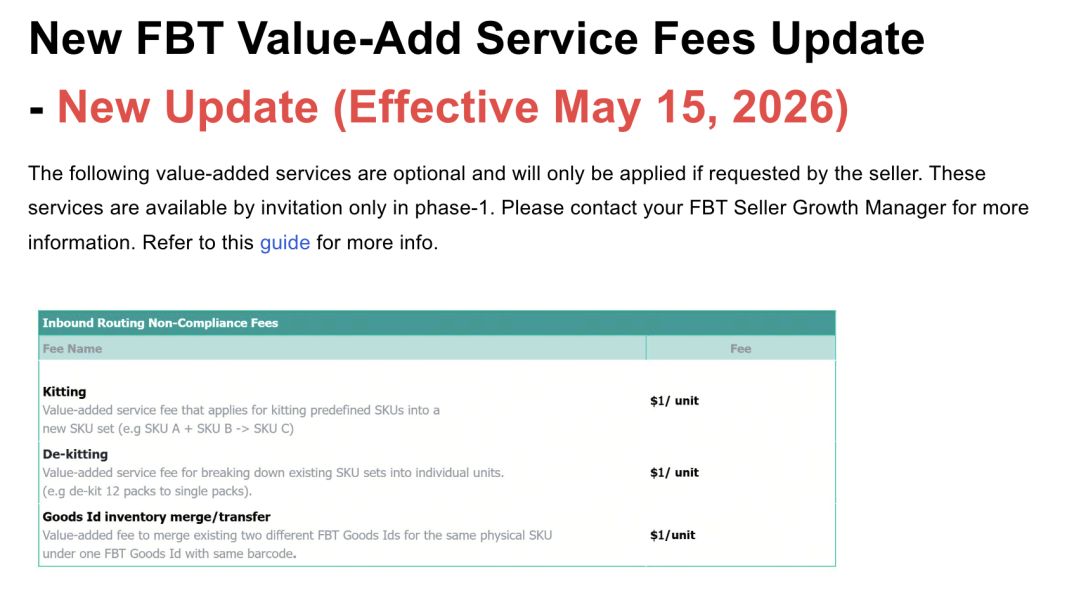
The Value-Add Service fees formalize a set of tasks that many sellers historically expected their warehouse or 3PL to absorb as part of operations. Under the May 15 update, TikTok now lists at least three billable services for FBT:
- Kitting – $1 per unit: Combining predefined SKUs into a new set (e.g., SKU A + SKU B → SKU C).
- De-kitting – $1 per unit: Breaking down existing SKU sets into individual units (e.g., de-kitting case packs into singles).
- Goods ID inventory merge/transfer – $1 per unit: Merging two FBT Goods IDs for the same physical SKU into a single ID with a shared barcode.
These fees are optional and only apply if requested, but they put a hard price on complexity that used to be buried in overhead. For many brands, this will trigger a rethink: should kitting be done at the factory, at the 3PL, or at TikTok — and where does it make the most financial sense?
Can Sellers Still Use 3PLs for TikTok Shop?
TikTok’s 2026 fulfillment story has been messy enough that many sellers have treated each new update as provisional. Early-year coverage described a harder push toward TikTok-controlled shipping workflows in the U.S., creating real concern that sellers would be forced away from their own systems and toward a narrow slate of TikTok-approved methods.
At the same time, enforcement details and partial reversals created confusion rather than clarity. First, TikTok appeared to want everything in native logistics (FBT or TikTok Shipping). Then it stepped back from the hardest edges of that stance after seller pushback. Now it is publishing new rate cards and incident fees that don’t ban outside fulfillment, but make it clear that anyone touching TikTok orders – including 3PLs – has to play by TikTok’s routing, labeling, and inbound rules.
That’s the larger theme: TikTok has not banned outside fulfillment across the board, but it is tightening its grip over the parts of the workflow it sees as most critical: labels, routing, inbound quality, and the outbound promise made to the customer.
TikTok is Making Fulfillment Part of the Marketplace Experience
TikTok still wants to present FBT as more than a warehouse product.
The official FBT page says sellers can use TikTok-managed storage, picking, packing, and shipping; receive free 3-day delivery on eligible items; and potentially improve conversion and product visibility through the FBT badge.
That positioning makes FBT look less like an optional back-end service and more like a commerce infrastructure layer TikTok wants sellers to trust with a bigger share of the order journey.
By revising the economic terms around compliance and inbound behavior, TikTok is doing more than adjusting fees. Platforms make these kinds of changes when they want logistics performance to become a controllable part of marketplace quality, not a variable left mostly to merchants and their outside partners.
The Amazon Comparison: When Logistics Becomes a Profit Center
Amazon has spent years trying to own the fulfillment stack: first to support its own retail operations, then to power FBA, and now increasingly to serve merchants and shippers outside the traditional marketplace model.
In May 2026, Amazon formally launched Amazon Supply Chain Services, opening its freight, distribution, fulfillment, and parcel-shipping infrastructure to businesses of all sizes. That makes Amazon the clearest example of what a mature full-stack logistics strategy looks like.
TikTok is not there yet, but its 2026 fulfillment decisions suggest it is exploring a similar logic:
- More platform control
- Stronger incentives to use native logistics
- Tighter compliance expectations
- More standardized rules for outside providers
The key difference is maturity. Amazon is monetizing a logistics empire it already owns at scale and is doing so aggressively: AWD, MCF fee increases for 2026, as well as stricter prep and inbound requirements for FBA, all reinforce that logistics is a profit center, not just infrastructure. TikTok is still deciding how far it wants to go and how much seller disruption it can tolerate.
That leaves a critical question for brands and 3PLs alike: will TikTok keep moving toward an Amazon-style fulfillment ecosystem, or will it eventually step back and let Amazon remain the dominant fulfillment behemoth while TikTok focuses more on demand generation and discovery?
What This Could Mean for TikTok Summer Deals
There is also a meaningful seasonal angle here. TikTok has previously used Deals For You Days to compete with Amazon’s Prime Day, tying participation to specific discount thresholds, campaign windows, and shipping-related requirements.
If TikTok runs a similar summer promotion in 2026, the June rate-card update will land right as sellers are planning or executing those campaigns. The same dynamics that show up in any peak-season fulfillment playbook — buffer stock, inbound lead times, and routing discipline under demand spikes — will apply here in a compressed summer window.
New incident-fee exposure and tighter inbound expectations could push sellers to plan earlier, but they could also make teams more cautious if their FBT or hybrid-fulfillment setup is not stable going into a major promotional push. That is especially relevant because Amazon Prime Day 2026 has already been positioned as a June event, which raises the odds that brands are thinking now about competing summer offers across multiple channels.
If TikTok wants to use another summer event to siphon demand from Amazon, fulfillment reliability will matter just as much as discounts and creator content.
FBT or Hybrid Fulfillment? Your Operational Review
For sellers, the immediate takeaway is operational.
Any brand using FBT, TikTok Shipping, or a hybrid setup with outside fulfillment partners should review the parts of the workflow most likely to create compliance risk before the June 18 changes are fully felt.
That includes:
- Routing discipline and adherence to TikTok’s allocation and shipping rules
- Inbound booking processes and on-time performance
- Carrier selection and label workflows aligned with TikTok’s requirements
- Tracking visibility across TikTok and 3PL systems
- Exception handling and communication when orders fall out of the standard flow
- Contingency plans if FBT capacity, routing, or cost becomes an issue during a campaign
Build Flexibility Before the Next Shift
The most useful way to interpret TikTok’s May and June 2026 updates is not as standalone fee tweaks, but as another move in TikTok’s ongoing attempt to define what kind of fulfillment platform it wants to be. The new FBT rate card makes that ambition more visible, but it does not resolve the central question hanging over TikTok Shop in 2026:
Will TikTok continue pushing toward greater ownership of the fulfillment experience, or will it stop short and let Amazon dominate full-stack logistics while TikTok focuses on demand, merchandising, and media-driven commerce?
The brands in the strongest position will be the ones that understand the new rate card and associated fees, control their inventory, and avoid building their entire fulfillment strategy around one platform whose economics can change with a single update.