Most sellers who pay Amazon’s placement fee do it to avoid a shipping decision, not because they’ve priced out what it does to sales. That’s backwards, but it’s an easy mistake to make: the placement fee shows up as a clean, single line item on your shipment plan. What it costs you in sales doesn’t show up anywhere.
Amazon placement fees look like a shipping cost, but Tactical’s internal SplitSmart™ data says the real cost shows up in sales… and it’s bigger than most sellers assume.
What an Amazon Placement Does and Doesn’t Get You
Paying Amazon’s placement fee may simplify the initial shipment, but it limits where your inventory starts. You send everything to one location, and Amazon redistributes it across its network over time, typically reaching only nine to 12 fulfillment centers.
That may reduce your upfront trucking cost, but it can also leave your inventory concentrated in fewer regions while Amazon completes the transfer process. The result is slower nationwide availability, longer delivery promises, and less control over how quickly your products become Prime-eligible.
SplitSmart™ by Tactical takes a different approach.
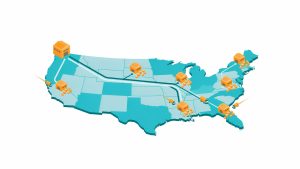
SplitSmart picks up your inventory once, splits it across five-plus Amazon-assigned destinations, and delivers it directly into the FBA network for one flat per-pallet rate.
Each destination can then feed additional fulfillment centers, giving your inventory the potential to reach 50 to 60 locations nationwide.
That broader distribution helps put inventory closer to more customers, faster. It can improve delivery speed, reduce the risk of regional stock gaps, and give Amazon more opportunities to offer your product with next-day or two-day delivery.
The difference is not simply one shipment versus five-plus, but limited regional coverage versus a stronger nationwide FBA footprint from the start.
RELATED: Q4 Signals from Prime Day – And What We Should Know for Peak 2026
Amazon’s Algorithm Rewards Proximity, Not Best Sellers
Amazon’s ranking algorithm is built around shipping cost, not product promotion.
That means product closer to a buyer gets pushed harder than product that has to travel further to reach them.
That’s a non-issue for the sellers moving 60,000 to 500,000 units a month. They dominate most regions regardless of how their inventory is placed.
It is, however, a real issue for the seller doing well overall but with a clear regional gap – for example, strong in the Northeast, but invisible in Texas, where a competitor already owns the shelf.
A single placement locks that gap in, but experienced sellers already know that if it doesn’t benefit Amazon (which it doesn’t), then Amazon has no reason to correct it on your behalf.
This is the exact gap SplitSmart™ was built to close.
RELATED: Amazon FBA Check-In Process Explained: Peak Season 2026 Timing
SplitSmart’s Number: 4% Average, 7% at the High End
Tactical ran an internal analysis across 17 SplitSmart™ sellers, comparing sales performance under single-location placement against SplitSmart’s five-way split. The average sales increase after switching to SplitSmart™ was 4%. The strongest result in the group was 7%.
Four percent doesn’t sound dramatic next to headlines promising to double your revenue, but it’s an average pulled from real SplitSmart™ accounts, not a projection, not a guess, not a claim.
And, if you run that against $1 to $3 million in annual revenue, suddenly it’s not a rounding error; it’s tens of thousands of dollars sitting on the table because inventory landed in the wrong 12 fulfillment centers instead of the right 50.
Other Hidden Costs: FC Transfer Delay
Placement fees also cost you time before they cost you sales. Inventory delivered to a single Amazon location takes roughly a week to a week and a half longer to become Prime-eligible than inventory split across five locations from day one, because it has to work through FC transfer before it’s fulfillable at all. SplitSmart™ shipments are typically fulfillable in 8 to 10 days, at a flat rate, with zero Amazon placement fees.
For a seller replenishing on an eight-to-ten-week cycle, that delay is a rounding error. For a seller running closer to a two-week cycle, especially heading into Q4, it’s the difference between staying in stock and losing a selling window to a slower supply chain, not a demand problem.
RELATED: The Forgotten Quarter: Q3 Freight Rates, Fee Resets, and What to Watch in Q4
The Tactical Takeaway: Optimize Splits and Get Checked In Faster
Placement fees get evaluated as a shipping cost, but they should be evaluated as a distribution decision.
Single-location placement trades a lower trucking bill for a smaller footprint and a slower path to Prime eligibility, and for any seller without total regional dominance, that trade shows up not just delayed sales, but lost ones.
Pull your sales by region and look for the gaps before you build your next FBA shipment plan. If you’re seeing strong performance in some states and near-zero in others where a competitor is active, that’s a distribution problem a single placement fee shipment will not fix.
SplitSmart™ delivers to five Amazon fulfillment centers from one flat per-pallet rate, with zero Amazon placement fees and inventory typically fulfillable in 8 to 10 days.