Amazon has published its Q4 and Holiday 2026 deadlines, and the most important update is not the peak fee schedule. It is how early inventory needs to arrive.
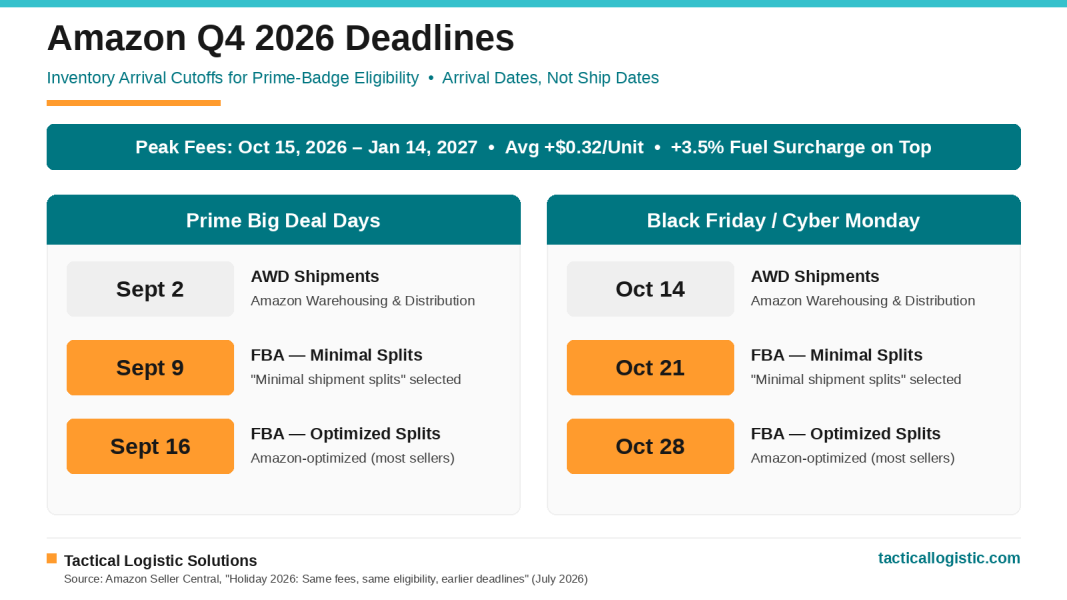
The first major inbound deadline is September 2, 2026, for Prime Big Deal Days inventory moving through Amazon AWD. For most FBA sellers, inventory needs to arrive between September 9 and September 16, depending on the shipment split option selected.
These are arrival deadlines, not recommended ship dates. Inventory must be received by Amazon, not sitting at a port, warehouse, carrier terminal, or fulfillment center receiving queue.
All dates and fees below come from Amazon’s official Seller Central announcement.
Prime Big Deal Days: 2026 Inbound Deadlines
Key Dates
| Date | Deadline |
|---|---|
| September 2 | AWD inventory must arrive |
| September 8 | Deal submission window closes |
| September 9 | FBA inventory must arrive when using minimal shipment splits |
| September 16 | FBA inventory must arrive when using Amazon-optimized shipment splits |
Amazon has not officially announced the event dates for its Fall Prime Big Deal Days event. It has only said the event will return around the same time as last year (early-to-mid October). Sellers should plan around the inbound deadlines rather than waiting for the event dates to be confirmed.
Promotion and Fulfillment Fees
| Fee | Detail |
|---|---|
| $100 plus 1.5% | Charged per promotion, plus 1.5% of promotional sales, capped at $5,000 |
| $50 discount | Available when deals are submitted by August 5 |
| Standard FBA rates | Apply before October 15, along with Amazon’s ongoing 3.5% fuel and logistics surcharge |
The difference between the September 9 and September 16 deadlines is especially important. Sellers choosing minimal shipment splits lose one full week compared with sellers allowing Amazon to optimize the shipment across multiple destinations.
That may simplify inbound transportation, but it leaves less room for delays and gives Amazon more control over how inventory is distributed.
SplitSmart™ gives sellers another option. Tactical picks up one shipment, splits it across five Amazon-assigned fulfillment centers, and manages the transportation to each destination at one flat rate per pallet. Sellers can avoid placement fees while still starting Q4 with broader fulfillment-center coverage.
Learn how SplitSmart™ works or book a call to build your inbound plan around Amazon’s deadlines.
Black Friday and Cyber Monday: 2026 Inbound Deadlines
Key Dates
| Date | Deadline |
|---|---|
| October 14 | AWD inventory must arrive |
| October 20 | Deal submission window closes |
| October 21 | FBA inventory must arrive when using minimal shipment splits |
| October 28 | FBA inventory must arrive when using Amazon-optimized shipment splits |
Peak Fees
| Fee | Detail |
|---|---|
| Average increase of $0.32 per unit | Peak fulfillment fees apply from October 15, 2026, through January 14, 2027 |
| Additional 3.5% | Amazon’s fuel and logistics surcharge is added on top of peak fulfillment rates |
| $100 plus 1.5% | Charged per promotion, plus 1.5% of promotional sales, capped at $5,000 |
| $50 discount | Available when deals are submitted by September 5 |
Peak fulfillment fees are based on when an order leaves an Amazon fulfillment center, not when inventory arrived. Products shipping to customers on or after October 15 will incur peak rates, even if the inventory was delivered to FBA months earlier.
What Peak Fees Look Like by Product
Amazon’s average increase of $0.32 per unit does not show how widely peak costs can vary by product size.
| Product | Size Tier | Non-Peak Fee | Peak Fee |
|---|---|---|---|
| Mobile device case | Small standard | $2.49 | $2.68 |
| T-shirt | Large standard | $6.14 | $6.53 |
| Baby cot | Small bulky | $10.21 | $11.25 |
| Television | Extra large, 50–70 lbs. | $48.57 | $51.38 |
These increases apply across FBA, Remote Fulfillment with FBA, Multi-Channel Fulfillment, and Buy with Prime.
The largest impact will fall on bulky and heavy products. A baby cot, for example, increases by more than $1 per unit before the additional 3.5% surcharge is applied.
Amazon has also warned that seller capacity limits may decrease in November and December as fulfillment centers shift resources away from receiving inventory and toward processing customer orders.
That makes late replenishment more difficult at exactly the point when sellers have the least room for error.
Related: Amazon Post-Prime, Pre-Peak Review: What July’s Changes Mean for Your Q4
Amazon Is Expanding Its Network Further Upstream
Amazon also announced a new Global Warehousing and Distribution facility in Shanghai, joining its existing Shenzhen location.
The new facility gives sellers another option for storing U.S.-bound inventory in China before moving it into Amazon’s broader logistics network.
That convenience may make sense for some businesses. It also gives Amazon more control over where inventory is stored, when it moves, and which fees apply throughout the supply chain.
Sellers should evaluate the full cost, timing, and inventory-control implications before treating Amazon’s upstream logistics network as the default option.
September Deadlines Create an August Shipping Problem
The September 9 deadline may appear to leave sellers with more than a month to prepare. For import-driven brands, it does not.
Work backward from the required Amazon arrival date:
- Amazon receiving and check-in time
- Domestic transportation
- Warehouse receiving, prep, and labeling
- Port pickup and drayage
- Ocean transit
- Origin preparation and loading
For many sellers importing from China, inventory may need to be on the water in early August.
The minimal-splits deadline also reinforces the tradeoff behind Amazon’s placement fee structure. Sellers can pay for fewer inbound destinations, but they receive a tighter deadline and begin with inventory concentrated in a smaller portion of Amazon’s network.
Five-way distribution can provide a wider starting footprint. In Tactical’s analysis of 17 SplitSmart™ accounts, five-way splits averaged a 4% sales lift compared with single-placement shipments.
Read the full breakdown in our Amazon placement fee analysis.
The Tactical Takeaway: Review Critical Deadlines Now
Do not build your Q4 inbound plan around October. Build it around September 9, or September 2 if you are using AWD.
Pull your Q4 forecast now. Identify the SKUs that need to be available for Prime Big Deal Days and Black Friday. Book August freight before capacity tightens. Most importantly, decide how you want inventory distributed before Amazon’s deadlines leave you with fewer options.
SplitSmart™ by Tactical delivers shipments to five Amazon-assigned fulfillment centers at one flat rate per pallet. Sellers can avoid placement fees, expand fulfillment-center coverage, and move inventory into Amazon without coordinating multiple carriers and destinations themselves.
During Q4, the value is not limited to transportation cost. Faster check-in and wider inventory distribution can help products become fulfillable sooner, protect Prime eligibility, and reduce the risk of losing sales while inventory sits in transfer or receiving.
Q4 waits for no one.
Book a free Peak Season Fulfillment Strategy sessionwith the Tactical team to build an inbound plan backward from Amazon’s deadlines.